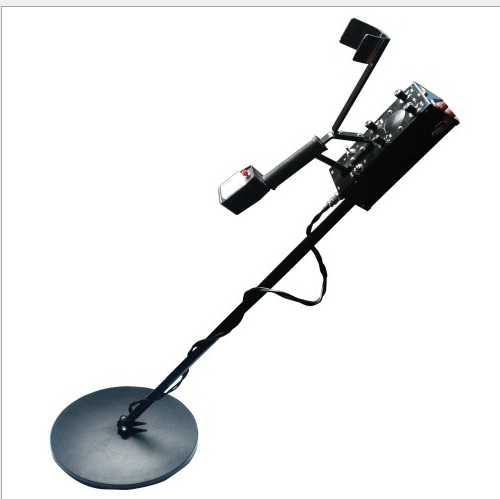
The CS-3D metal detector is a product manufactured using advanced foreign technology. The instrument is designed to be precise, utilizing high-quality imported components. It offers a large detection depth, accurate positioning, strong resolution, and user-friendly operation, embodying the technological style of the new era. The metal detector is primarily used to detect and identify buried metal objects underground. In addition to its military applications, it can also be used in:
Investigation and search by the public security criminal investigation department
Inspect metal items in your mail and luggage.
One of the most annoying problems with old-style metal detectors is the ground's influence. As the probe moves away from the ground, the instrument's signal changes, and if the probe sweeps over uneven ground, the change is even greater.
The operator seems to hear signals everywhere, unable to determine where the metal is truly buried. This phenomenon is called "mineralization reaction." The cause of the "mineralization reaction" is due to the various minerals in the soil causing the instrument to emit signals.
The place with a complex soil structure" has a very strong mineralization reaction, and the signal it causes is even larger than that of metals. It makes it very difficult for operators to determine whether the place where the signal is coming from is buried metal or the mineralization reaction.
The CS-3D instrument is equipped with a ground balance circuit that can eliminate the influence of all "mineralization reactions," and it only sends a signal when the probe encounters metal, thereby significantly improving the detection depth and accuracy.
Main Technical Parameters:
Maximum Depth: 0-6 meters
Operation Mode: Ground Balance/Identification
Main Oscillation Frequency: 550KHZ
Signal frequency: 450Hz
Power Consumption: 3W
Power supply: 12V, 1.3AH/20HR
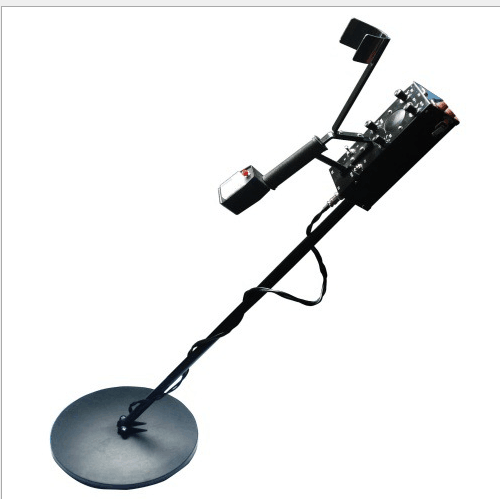 oneButton (Red)
There is a button at the bottom of the instrument. It is very important during the adjustment and operation of the instrument, and it is often pressed and released. After pressing and releasing the button, the memory circuit inside the machine automatically records the working state that has been adjusted. If the button is forgotten to be pressed and released, it will inevitably affect the detection depth.
Tuning knob
The function of the tuner is to tune in to the "critical sound." When you rotate the tuner clockwise from the left, first turn on the power switch, and as you continue to rotate to the right, the sound will start from nothing to something, from small to large. When detecting, it should be tuned to a slight "
The "buzzing" sound is very small, just enough to barely hear, which is known as "critical sound." Only when the sound is set to this faint level does the instrument achieve its highest sensitivity. If the "critical sound" is set too loud or is completely absent, the instrument's sensitivity will decrease.
When the sound is turned on, the sensitivity of the instrument will decrease. Before adjusting the 'critical sound', make sure to press the button, and once it's set, release the button. If during the detection process, the 'critical sound' gradually increases, decreases, or even disappears, it means that...
Press the button to restore the 'critical sound' and then probe again. After using the instrument, turn the tuner counterclockwise to the left end to turn off the power. Do not allow the instrument to remain on with the power switched off.
III. Operation Mode Switch (Identification/Ground Balance Switch)
The operation switch has two positions, one for ground balance and the other for identification. When the switch is set to the ground balance position, the instrument will emit a sound for all metals, and it can exclude the influence of 'mineralization reaction'. If the switch is set to the identification position, the instrument can distinguish between different types of metals.
Fourthly, the work adjustment knob (identification/ground balance knob)
The work adjustment knob is used in conjunction with the operation mode switch, and it is marked with a scale of 0-10. When operating in the ground balance mode, adjusting this knob can eliminate "mineralization reaction"; in the identification mode, it is used to distinguish between different types of metals.
Headphone Jack
The CS-3D instrument can be equipped with a headphone. After inserting the headphone, the sound of the speaker is interrupted, and the operator can hear the sound through the headphone, which is convenient for operation in noisy environments or at night.
Charging
The CS-3D instrument is powered by a battery and is equipped with a dedicated charger.
Metal detection methods:
Operating a CS-3D detector is akin to a soldier using a mine detector. When detecting, the probe should maintain a distance of 10-15 centimeters from the ground, moving along the surface in a parallel manner. Do not raise the probe too high, or the actual detection depth will decrease.
1. Geostatic Method
This method can eliminate the "mineralization reaction" of the ground, and it has better penetration, so it is often the first choice for both indoor searches and field operations. After detecting the presence of metal underground, the identification file is used to identify gold.
The type of metal. In the horizontal balance operation mode, as long as the probe is moved to the top of the target, the instrument will emit continuous sound, any type of metal will make the sound increase, and the instrument reading will rise. The adjustment process is as follows:
1. Switch the operation mode to the ground balance position.
2. Raise the probe to about 70-80 centimeters from the ground.
3. Press the button, rotate the tuner to turn on the power and tune to the "critical sound," and then release the button.
4. Place the probe close to the ground. About 10-15 centimeters from the ground, if the "critical sound" increases, lift the probe, press the button, and rotate the work adjustment knob slightly to the left (anti-clockwise direction), and release the button.
Niu, try again closer to the ground. If the sound still increases, you can repeat the process by rotating the work adjustment knob to the left a little more and trying again. After several adjustments, until the probe lifts and lowers with no change in the 'critical sound,' the ground
The balance is set. After such adjustments, the 'mineralization reaction' of the ground is essentially eliminated, and the probe can be moved freely on the surface without changing the 'critical sound'. Only when encountering a metal target does a signal occur.
Send out.
5. If the probe's sound becomes softer when it is close to the ground, lift the probe, press the button, and rotate the work adjustment knob to the right (clockwise). Release the button and try it again when it is close to the ground. If the sound still becomes softer, adjust it again until the sound remains the same when the probe is lifted or lowered.
6. Note: Before making any of the above adjustments, press the button, and after adjusting, release the button.
7. After the above adjustments, you can slowly move the probe along the ground. During the detection process, the instrument should maintain a constant buzzing sound – the 'critical sound'. If the sound gradually increases or decreases, you can press the 'press and release' button to restore the 'critical sound' to normal. When encountering metal, the instrument will emit a louder sound, and the electrical meter will also show a larger reading.
II. Identification Method
This method can distinguish between non-ferrous metals and ferrous metals, and can also select the metal targets needed and unnecessary based on sound and instrument indicators. The identification method does not have the role of ground balance, and cannot exclude the impact caused by soil structure. This requires that the probe maintain a constant distance from the ground and move slowly and parallel to the ground surface. The adjustment process is as follows:
1. Switch the operation mode to the recognition gear.
2. Press the button. Select the tuner to turn on the power and tune to the 'critical sound'.
3. Adjust the recognition knob according to specific conditions to exclude the targets that are not needed. For example, when detecting in an area with a lot of scrap iron nails, it is very inconvenient because everywhere there are signals from iron nails, making the detection work very inconvenient. In such a situation, you can adjust the recognition knob to exclude the signals from iron nails to improve the detection efficiency.
You can place a nail on the ground in advance, and let the probe sweep over the nail on the top, if
The sound of the instrument increases, press the button, and rotate the "Work Adjustment" knob to the left (anti-clockwise direction) a little, release the button and probe again. If the sound decreases, move away the probe in the same way, press the button, and rotate the "Work Adjustment" knob to the left (anti-clockwise direction) a little, release the button and probe again.
节"向右(顺时针方向)旋转一点,放开按钮再把探头移到铁钉上试一次,直到声音
Until the adjustment is made, the sound of the instrument will not increase if there are iron nails or smaller black metals buried in the ground, but will increase if there are non-ferrous metals or larger black metals.
4. Adjust the work to the scale of 2 or below, and the larger colored metals will make the sound louder, while the larger black metals will make the sound quieter; Adjust the work to the scale of 7 or above, and the larger colored metals will make the sound quieter, while the larger black metals will make the sound louder.
The black metal block makes the sound louder. If the target identified is a larger black metal sheet, there will be a particularly unusual phenomenon: when the probe moves along the edge, its reaction is the same as that of black metal, but when the probe
When facing the center of the thin plate, its reaction is the same as that of non-ferrous metals.
Three, Detection Examples
The above introduces two operating modes of the instrument. When operating the instrument in actual detection, the operator should use the instrument according to the specific situation. For example, in an ancient house to find buried relics, as the underground has been buried for a long time, various
Various metal debris such as nails, copper wires, old locks, fragments of iron pots, etc., will also emit strong signals. In this case, firstly, move all metal furniture out of the house, and then use
The ground balance probe identifies the metal debris and removes it, and only after carefully working to dig out all the metal items in the shallow soil layer can the search be extended to deeper areas. The detection work is a meticulous and arduous task that requires
Please be patient, confident, and persistent. No detector can clearly display the underground metal objects, it can only roughly predict the location of the metal targets. If you want to accurately find what you need, you also need to operate with precision.
The author has rich experience and carefully analyzes the instrument's reaction to make the correct judgment.
Detector maintenance
Cleaning: The probe portion is the most easily dirty, and it can be cleaned carefully with a damp cloth. However, the plug connected to the probe cable must not get wet, as the instrument will lose its detection ability if the plug gets wet. In this case, the plug must be dried before use. The instrument box is not waterproof and cannot be washed with water; it can only be wiped clean with a cloth. Do not operate the instrument in the rain.
Temperature; Do not place the instrument near a stove or other high-temperature environment.
Saltwater; Saltwater has great corrosiveness, if the instrument comes into contact with saltwater, it should be immediately washed with water, be careful not to let the water into the machine box, and quickly wipe it dry with a towel.
Warranty; Each instrument is accompanied by a warranty card, with a free warranty period of two years. During the warranty period, repairs can be made free of charge by presenting the warranty card. Please do not open the machine box or change the wiring without authorization.