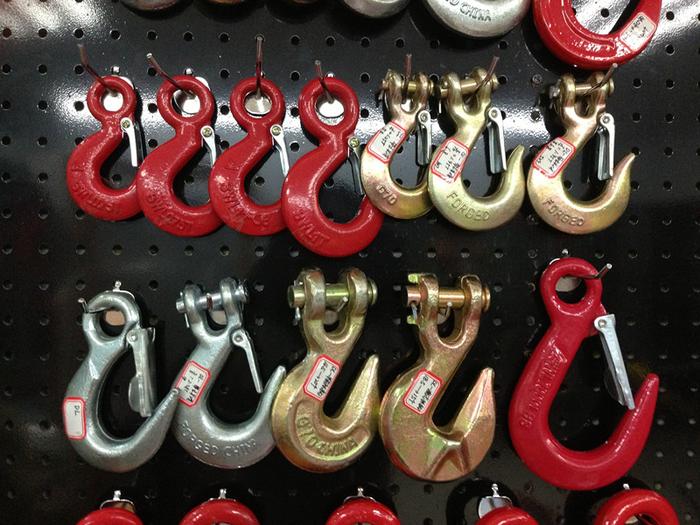
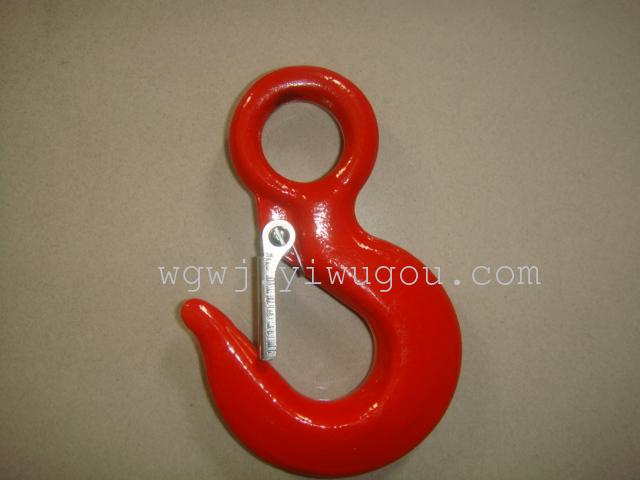
Material: Carbon steel, alloy steel
Specifications: 0.5T, 0.75T, 1T, 1.5T,.......3OT
Color: red, yellow, galvanized white, black, etc.; colors can also be customized according to client requirements.
Usage and Precautions for Loop Eye Hooks
When using the loop eye hook with rigging, attention must be paid to environmental conditions; additionally, the rigging must not be twisted or knotted during use. During lifting operations, it is strictly prohibited for the items being lifted to experience collisions or impacts.
Currently, ring-eye hooks are generally made as forged single hooks. Cast hooks are not allowed to be used on cranes, and ring-eye hooks are commonly manufactured from low-carbon steel and carbon alloy steel.
The hook serves to connect the crane and heavy objects, and its maintenance must be given due attention. Therefore, if the lifting height limiter or hook locking device of the hook fails or is damaged, it must not be used anymore; as for those operating without a license, leadership responsibility should be pursued. To ensure safety, the hook must be inspected, and if any of the following conditions are found, it should be discarded immediately.
①Cracks appear.
② The wear amount on a dangerous section shall be no more than 5% of the original height for hooks manufactured in accordance with GB10051.2; for hooks manufactured in accordance with industry standards, it shall be greater than 10% of the original size.
③ The mouth opening range has increased by 15% compared to the original.
④ Torsion deformation exceeds 10 degrees.
⑤ Plastic deformation occurs at the dangerous section or the hook neck.
⑥ When the wear amount of the plate hook bushing reaches 50% of the original size, the core sleeve should be scrapped.
When the wear amount of the plate hook core shaft reaches 5% of the original size, the core shaft should be scrapped.
Another point to note is that the above defects of the hook must not be repaired by welding.
Main methods for inspecting the hook: Generally, visual inspection is used, which involves careful observation with a magnifying glass. When necessary, coloring method or flaw detection can be applied. The wear amount on dangerous sections can be measured using a caliper or a clamp; the opening size is determined by comparing the measured dimension with the original size or the opening size of a standard hook. Here is a simple and applicable method: when a new crane hook is first installed, make small holes on both sides of the hook body opening, measure the distance between the holes, and record it. This allows comparison with the dimensions after the hook deforms in the future to assess the extent of the opening size change. Twist deformation can be inspected visually or measured using a steel ruler; for precise results, a marking tool can be used on the platform. Items ⑤, ⑥, and ⑦ can be inspected visually or with a caliper.