A hand-operated hoist is a simple-to-use, portable manual lifting tool. It can be used for lifting, pulling, lowering, and calibration operations. The lifting capacity generally does not exceed 50T. It is widely used in the installation of equipment in sectors such as shipbuilding, power, transportation, construction, mining, and postal services, as well as for lifting items and pulling machinery components.
When pulling an object using a dynamic pulley, the forces on both sides of the rope are equal, and each is half of the gravitational force being pulled. The person only needs to pull one side, so they only have to bear half of the weight, while the other half is borne by the object fixed at the other end of the rope. In essence, it is a method of torque balance; increasing torque can reduce force, which is the principle of levers.

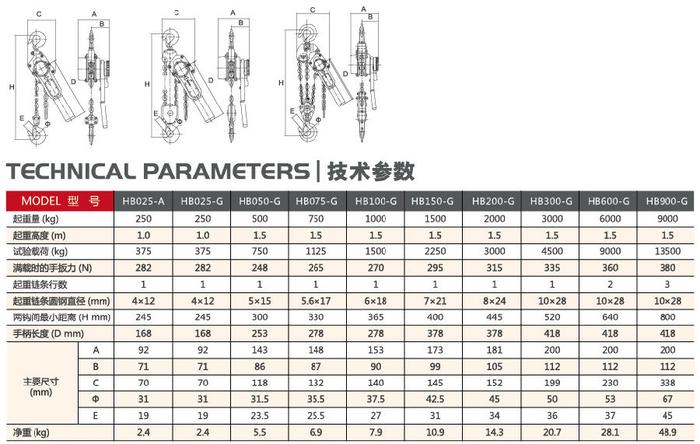
Usage Instructions
1. Overloading is strictly prohibited, extending the handle without authorization is strictly prohibited, and operation using any power other than human force is strictly prohibited.
2. When lifting heavy objects, it is strictly prohibited for anyone to perform any work or walk under the load to prevent personal injury.
3. Before use, it is necessary to ensure that all components are intact, the transmission parts and lifting chains are well lubricated, and the idle operation is normal.
4. Before use, check whether the upper and lower hooks are securely attached. The load should be applied at the center of the hook cavity. There must be no miswired or bent links in the lifting chain to ensure safety.
5. If you notice excessive manual effort during use, stop using it immediately and conduct a check:
A. Is the heavy object connected to other objects?
B. Is the gourd machine component damaged?
C. Does the weight exceed the rated load of the gourd?
6. No unauthorized operations are allowed; do not place the gourd in rain or very humid areas.
7. It is strictly prohibited to flip the hook of a 6-ton gourd between two rows of chains.
8. Before use, a safety inspection of the manual hoist should be conducted, including checking whether the grips of the manual hoist have severe wear, whether the wire rope needs replacement, and whether the brake surface is contaminated with oil sludge.
9. Always use the device in accordance with the standards for hand-lifted hoists. Do not arbitrarily extend the wrench length, and do not exceed the load capacity to avoid potential hazards during use.
Usage Instructions
1. Choose a hand-lifted hoist of appropriate size for use; overloading is strictly prohibited.
2. Conduct a safety check on the hand-pulled hoist before use, and also perform a no-load test on it. Adjust the position of the lifting hook appropriately according to actual requirements.
3. The method to adjust the lower hook is as follows: turn the toggle block to the “N” position, rotate it counterclockwise and pull out the handwheel. At this point, the clutch is open, and pulling out the chain allows for easy adjustment of the lower hook position. After adjustment, rotate the handwheel clockwise to return it to its original position.
4. After adjusting, hang the heavy object at the middle position of the lower hook, and turn the handle to lift the heavy object.
Maintenance Instructions
1. After use, clean the gourd thoroughly and apply anti-rust oil, then store it in a dry place.
2. Maintenance and repair shall be carried out by those familiar with the hoist mechanism, to prevent unauthorized disassembly or assembly by individuals who do not understand the machine’s operating principles.
3. Gear installation shall be carried out in accordance with the drawings.
4. When installing the groove-type nut, first turn the handwheel clockwise to press the ratchet and friction plate tightly against the braking air seat before attaching the groove-type nut.
5. After cleaning, inspection, and maintenance, the gourd should undergo no-load and load tests to ensure it operates properly and is reliable automatically before being put into use.
brakeThe friction surface must remain clean; oil sludge and sewage are strictly prohibited.
10. After the hand-operated hoist is used, it should be cleaned promptly. After cleaning and maintenance, no-load and load tests should be conducted. Once the hand-operated hoist is in good condition, it should be stored properly in a well-ventilated and dry place.