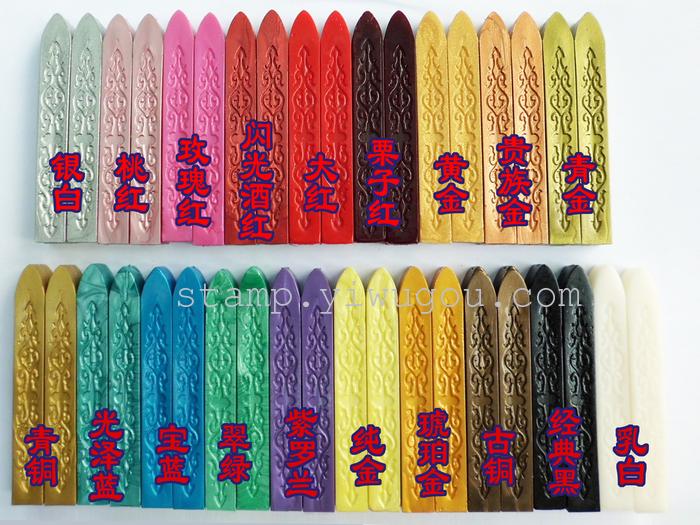
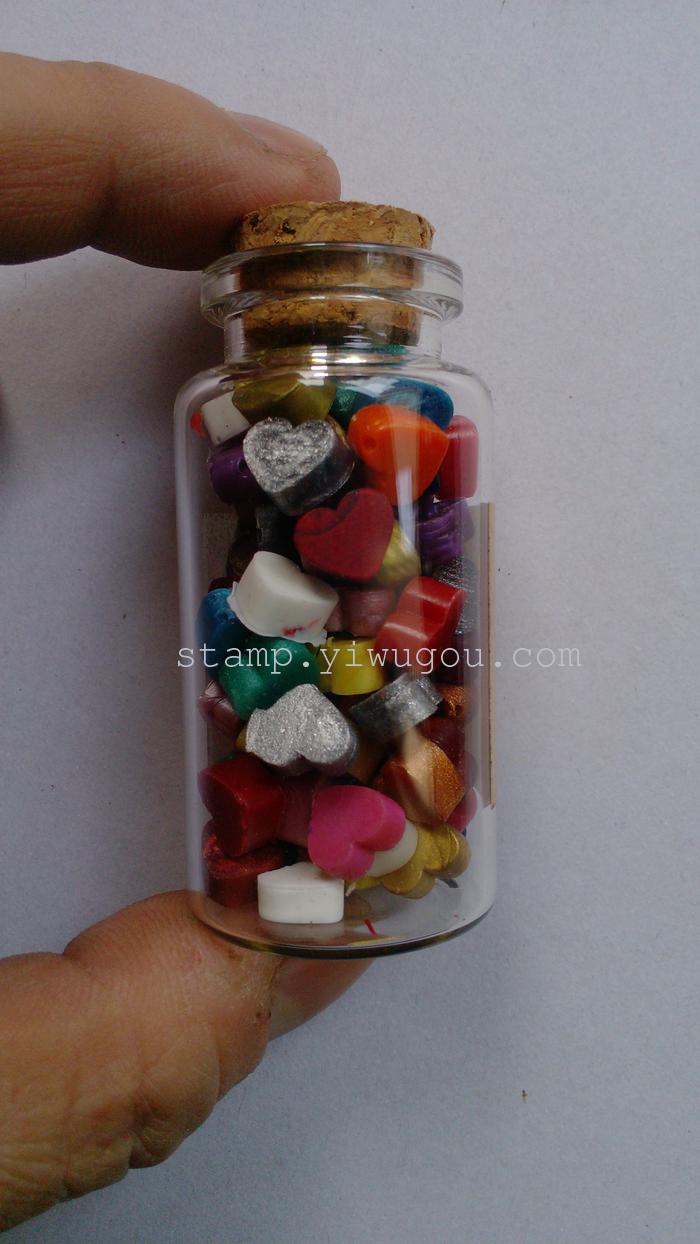
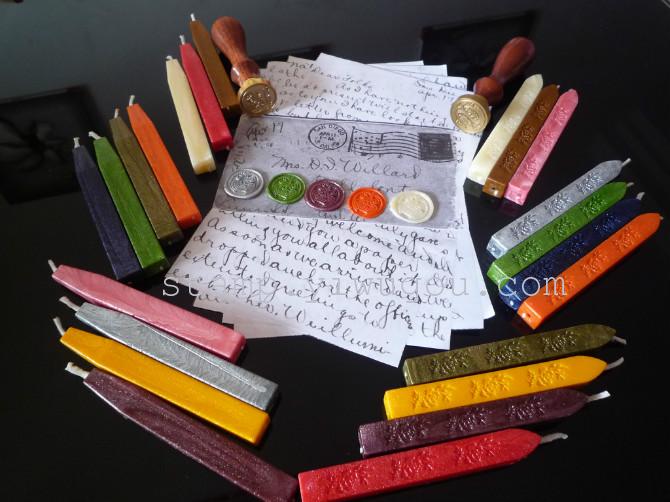
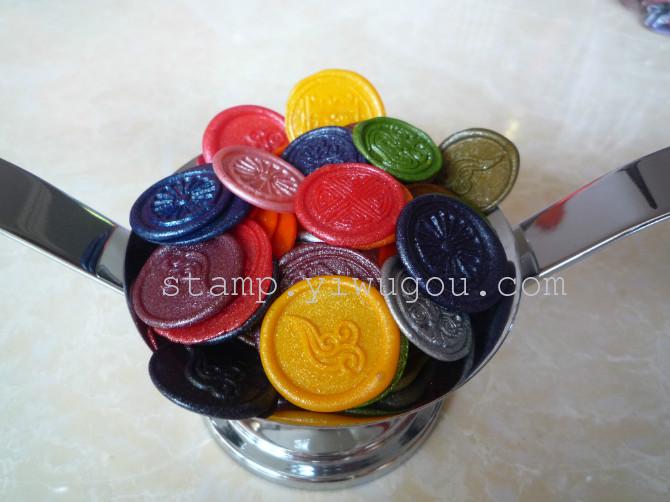
Wax seal, also known as "sealing wax" or "sealing paint", is a mixture of pine resin, paraffin wax, and tar with pigments heated to form blocks or strips. It is usually red or brown, but can also be made into special colors such as blue or white. When heated, it becomes soft and sticky, and is exclusively used for sealing bottle openings and sealing letters. When sealing, a candle flame is used to ignite the wax seal, and it is dropped onto the place where it needs to be sealed while it is melted into a thick consistency. Before it solidifies, a seal is covered, and after cooling, a clear seal pattern is left. It is not only beautiful but also effectively prevents private opening. In addition, wax seal is also applied to the adhesion of goose feathers in goose feather letters to prevent the goose feathers from falling off.
Wax seal is a form of sealing compared to "clay seal", and wax seal stamp is a kind of seal suitable for wax sealing conditions. In order to facilitate observation and inspection, it is often engraved with the name or logo of the organization in negative text. The choice of the "Xiangyun wax seal stamp" as the Olympic Games logo is a specific product under the condition of wax sealing.
With the development of paper-making technology and the improvement of paper quality, envelopes have been changed from multi-layered to single-layered, which has been used until now. Sealing wax envelopes were popular among officials and civilians during the Ming and Qing dynasties; during the period of the Republic of China, they were used by government agencies but were less common among the public.
Section Three: The Luminous, Troubling, and Fading Glory of Sealed Wax
Wax seal is the basic condition for forming wax seal seal, and wax seal seal is the main guarantee to prevent the wax seal seal from being opened. Some people say that the French invented wax seal in 1626; some people say that the Chinese invented it in the 11th century, and it was introduced to Europe from India, and soon became a magic weapon for Europeans to conservethe secret of communication. It is also said that Liu Bang, the first emperor of Han Dynasty (206 BC - 195 BC), used wax seal seals, and it was auctioned for 400,000 Hong Kong dollars at a Hong Kong auction (Wikipedia: Origin of Wax Seal). There are many opinions, which need to be verified. However, one thing can be confirmed is that wax seal seal is an extension and development of the seal form of bamboo slips and wooden tablets, and it should be used after the bamboo slip seal. That is to say, wax seal seal should be used in the period after the Jin Dynasty in the second and third centuries AD. Obviously, the French invented in 1626 is too late. As for the invention of China through India to Europe, it can be verified; however, Liu Bang used wax seal seals should be an indisputable fact, because the "clay seal" before wax seal seal is also a need to seal. The difference is that the former is covered on clay, and the latter is sealed on wax seal. Over time, it can also be called "wax seal seal". In fact, looking back at the existence form of wax seal seal, the key is to understand its historical achievements in the transmission of important letters and the protection of information rights.
Since the Jin Dynasty, paper and silk have been widely used, with seal wax sealing being used until today, with a long history. It has played a positive role in the application of important documents, valuable items, cultural relics' export, and cultural relic identification and protection. In the 22nd year of the Guangxu Emperor of the Qing Dynasty (1896), the national postal service was established, which stipulated that envelopes should have red stripes, written with a regular brush, and sealed with a seal. Precious items were sealed with seal wax. Although there were changes in the period of the Republic of China, the old system was continued and widely used in government secret documents. The French used seal wax to add sealing, differentiating the content by the color of the seal wax, red wax for official documents, brown wax for invitation to a banquet, and white wax for weddings and celebrations. It is worth noting that the sealing with seal wax is also adopted by the Universal Postal Union, stipulating that it is used for valuable mail items of countries and the packaging of precious cultural relics.
In the early days of New China, some organizations, enterprises, institutions, and schools used seal wax to seal personal files and important documents. However, with the improvement and development of the postal operation system, it also created very favorable conditions for the reform of the form of sealing for confidential letters. Although the "seal wax seal" has a form of strict confidentiality, the emphasis on the seal wax seal is actually "seeing the object but not the person," and if the person's character is not good, what use is the seal? Especially, marking the nature of the letter clearly with seal wax seal may expose it too much. At the same time, the seal wax seal is cumbersome, and it is melted, dropped, and stamped early, which leads to blurring and indifference, and also leads to the gradual disappearance of the seal wax seal.
Note: ①③ Shi Shui Lang, "The Age of the Post," Shaanxi People's Press, 2002 edition, pp. 1-3.
② Shi Shui Lang's "The Age of Post Roads and Stages" published by Shaanxi People's Publishing House, 2002 edition, page 10.
④⑤ Liu Zubian, "The Way of Letter Transmission, Information Carried by the Medium, and Its Application in Special Stamp Collections," in "Han River Philatelic Papers," page 55.
⑥ Shi Shui Lang, "The Age of Post Roads," Shaanxi People's Publishing House, 2002 edition, p. 9.
⑦⑧ "Dictionary of the Sea," published by Shanghai Dictionary Press in 1979, page 1887.
Originally published in the 'Yuexiang Philatelic' (Total Issue 112 and 113).
Another seal description
火漆,又称为封蜡,英文名:SEALING WAX
Wax seal (also known as sealing wax, used for sealing postal letters, documents, or confidential items to prevent others from opening them),
is a relatively ancient method. In ancient times, people would apply melted wax from a candle to the seal of important documents, letters, secret messages, or packages, and then press their seal onto the wax while it was still hot. This way, anyone attempting to open the document or package without authorization would cause the wax to crack or break, revealing the attempt.
In 3000 BC, the clay tablets of the Assyrians and Egyptians were enclosed in clay covers, which were the world's earliest envelopes.
Later, people rolled up letters written on animal skins and parchment into a roll, tied them with thin leather strips (often from the same animal skin), and sealed them with wax. With the advent of paper, letters were folded, and the reverse side of the paper was used to write names, addresses, and relevant mailing instructions. The edges of the paper were sealed with wax, and this practice continued in Europe until the 1860s. In other parts of the world, it was even later.
The earliest paper envelopes were handmade, with the process being: cutting the paper, folding the corners to overlap, placing the letter inside, and sealing the overlapping corners with wax seal. In 1790, France used machines to make envelopes, but they did not become popular because using machine-made envelopes actually doubled the postage cost. After 1840, when postage was no longer calculated by the number of sheets of paper, envelopes gradually became widely used. Despite this, the habit of folding the outer edge of the envelope in the UK and then sealing it with glue or wax continued until the 1850s. Envelopes used for mailing before 1840 are extremely rare, and therefore they have become highly sought-after stamps by philatelists at high prices.
About the Imperial Edict Documents
The rule of medieval European kings, besides military conquest, also required the management of documents, the issuance of edicts, and the statistical management of finances. Therefore, the system of seal and document also continuously developed, and it promoted the improvement of the monarch's seal system. After the fall of the Roman Empire, the administrative seal system was also different from the past, with only a few kings having seals. Influenced by Roman civilization, early kings of countries such as France generally had "gem seals," which were usually set with a gem on a ring and engraved with an imprint on the gem. The diameter was about 5-6 centimeters, and they were generally circular. The composition of the imprint was simple, consisting of inscriptions and patterns. The inscriptions were the names and titles of the emperor, and the patterns were the emperor's head or half-body portrait.
From Otto II, a seal form that was later revered as the model for the design of royal seals – the "Seal of Sovereignty" – began to become popular. This seal design usually depicts the emperor wearing imperial robes, wearing a crown, sitting on a throne, holding a scepter in his right hand, and supporting a cross ball with his left hand. Later, double-sided seals appeared, with the front showing the solemn image and the back usually being the king's knight seal or the family crest seal of the king's family. This type of king's seal, mainly used for formal edicts, is usually called the "Great Seal of Administration."
With the development of the times, paper replaced parchment, and seal wax gave way to a form of seal known as "private seal." This seal form, in fact, was also seen as a revival of the early king's seal ("jade seal"). This private seal later evolved into smaller ring seals, primarily used for sealing the envelopes of the king's letters. Private seals are generally single-sided seals with the royal crest engraved on them. The inscriptions are simple, usually reading "Secret Record of King So-and-so," hence sometimes being referred to as "secret seal."
The king's" grand seal is generally only engraved once for life. However, if a new title is needed, a new seal is engraved, such as when King Edward III of England officially announced himself as the king of France and England in 1340, he had a seal engraved. When he again announced himself as the king of France in 1360 and signed the "Bretagne Treaty," he had another new seal engraved. In general, when a new king succeeds, an ceremony is held to destroy the old seal (especially the "grand seal"). After a few months of Edward III's succession, he held a ceremony to break the jade seals used by his father and grandfather in person. As for the king's private seal, there are no special regulations on quantity and other aspects.
The manufacture of wax sealEditor
Wax seal is a kind of adhesive, slightly different from glue and paste, and is a special adhesive. Stationery is often used, and it is also often used in daily life, such as to avoid the opening of important documents and to seal one thing, etc., must use wax seal. The finished product of wax seal is a bar-shaped object, not easy to be damaged, so there is no need to be packed, and it can also be sold. The packaging is divided into 20 bars or a dozen separately wrapped to facilitate the sale.
Recipe and Preparation
Rosin 60, shellac 20, and synthetic Venice turpentine 20. The preparation method is to first put the rosin and shellac into a magnetic dish or copper vessel (it is absolutely necessary to avoid using iron to prevent deterioration). Heat it until it completely melts, and then slowly add the synthetic Venice turpentine. Wait until it cools down naturally. When it cools to the appropriate temperature, if you want to color it, you can add the pigment and stir it to make it uniform, and then pour it into the mold to allow it to solidify. Once it is completely solidified, you can remove it. For the fire seal, you only need to add pigments that dissolve in oils. The pigments for common fire seals are red and black. The red one is made by adding silver cinnabar, and the black one is made by adding lampsoot. The amount of pigment is about one-quarter of the basic agent of the fire seal.
Ingredients
(1) Rosin: Rosin is a type of resin that seeps from the trunks and bark of coniferous plants and various pine species. Once it dries, it becomes a light yellow, brittle block. Its fractured surface is striped, and it has a scent similar to turpentine. It is insoluble in water but soluble in alcohol, ether, vinegar, ketone, and wax, which makes it transparent. It can also be distilled to remove the volatile turpentine, resulting in a transparent, amber-colored brittle block, which is the transparent rosin sold on the market. Rosin is also known as resin.
(二)虫胶片:产于印度一带榕树上的一种小昆虫的"分泌物”,实际不是分泌物,而是此辈小虫为欲保护其自身起见,而刺破树皮所流出的树胶。
Gum mastic is a transparent, brittle sheet with a yellowish-brown or reddish-brown color. It is insoluble in water but can be dissolved in hot alcohol, potassium hydroxide solution, and borax solution. It melts slightly upon heating. The function of gum mastic is to be used as a binder and in the manufacture of fake lacquer.
Artificial Venice Turpentine: It is a man-made product, made by combining 62.5 parts of rosin and 22.5 parts of linseed oil in a pot, heating it with direct fire until it melts. After the fire is removed, 15 parts of turpentine are added, and it is stirred continuously to complete the process.
(4) Silver cinnabar is mercury sulfide; lamp coal is soot.