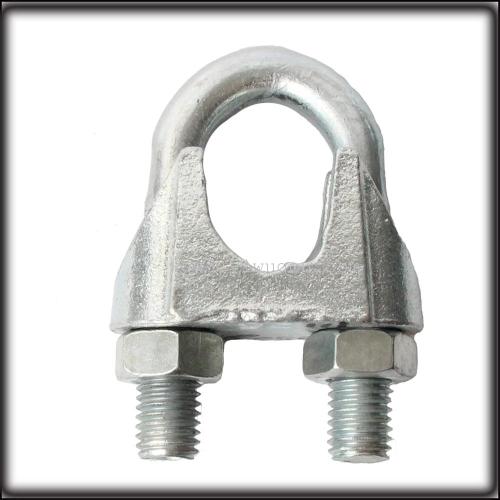
| Brand: koio |
Model: 741 |
Type: Card Holder |
| Custom processing: Yes |
Material: Steel |
Maximum Load: 1 |
| Scope of application: temporary connection of steel wires, securing the rear rope when the steel wires are wound around the pulley set, and securing the end of the winch rope on the derrick, etc. |
Specifications: 3MM|5MM|6MM|8MM|10MM|1/1/3MM|14MM|16MM|18MM|20MM |


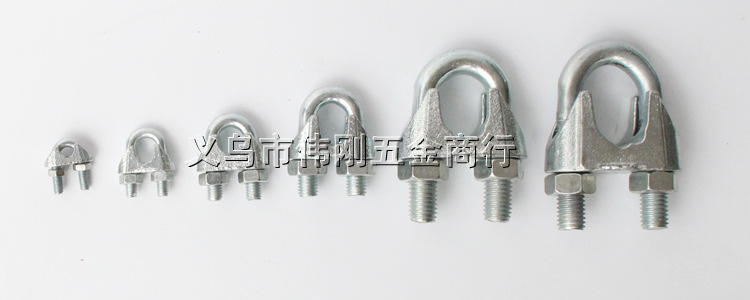

Precautions for using the wire rope gripper: It should not be used for long periods of time, must be inspected regularly, and should be scrapped periodically; it cannot be reused.
(1) The size of the clamp head must be suitable for the thickness of the wire rope; the inner clearance of the U-shaped ring should be 1–3 mm larger than the diameter of the wire rope, as an excessive clearance makes it difficult to secure the rope properly.
(2) When using it, tighten the U-bolt until the wire rope is flattened by about 1/3. Since the wire rope deforms under stress, the clamp needs to be tightened again after the rope is stressed to ensure a secure connection. If you want to check whether the clamp slides after the rope is under stress, you can add an additional
Safety ropeInstall the clamp there. The safety rope clamp is positioned approximately 500 mm from the last clamp. Release a section of the rope end to form a safety bend, then clamp it onto the main rope. In this way, if the clamp slides, the safety bend will straighten out, making it easy to detect and reinforce promptly.
(3) The spacing between the rope clamps is generally about 6 to 7 times the diameter of the steel wire rope. The clamps should be arranged in a straight line, with the U-shaped ring portion clamped on one side of the rope end, and the pressure plate placed on the side of the main rope.
(4) Correct arrangement of quantity and method:
The number of rope clamps generally should be no less than 3–5; the spacing between the clamps should be ≥ 6 times the diameter of the steel wire rope. The distance between the last clamp and the rope end should be ≥ 140 mm. The number of clamps depends on the diameter of the steel wire rope.
≤10mm: 3 units
10–20 mm, set to 4.
21–26 mm: Set 5
25-36mm, set 6.
7 units for 36–40 mm.
(5) Wire rope clamps should be used in conjunction with each other. When the wire rope diameter is less than 10 mm, there should be no fewer than 3 clamps; for diameters between 10 and 20 mm, there should be no fewer than 4 clamps. The spacing between clamps is generally approximately 6 to 8 times the wire rope diameter. The clamps should be arranged in a straight line, with the U-shaped ring portion attached to one side of the rope end, and the pressure plate placed on the side of the main rope.
After the wire rope gripper is installed, inspections should be conducted during the first and second loads to check for any looseness. Generally, the nuts need to be tightened further.
(6) When using it, the following two points should also be noted:
a) The size of the clip must be suitable for the thickness of the wire rope, including the inner side of the U-shaped ring
Clear distance, it must be 1–3 mm larger in diameter than the wire rope, and an excessively large clearance is not suitable
CardThe rope is prone to accidents. b) When tightening the clamp, make sure the bolts are tightened until the rope is flattened by 1/3–1/4 of its diameter. After the rope is under stress, tighten the clamp bolts once more to ensure a secure and reliable connection. c) The clamps should be arranged in a straight line, with the U-shaped part in contact only with the end of the rope and not with the main rope, as shown in figure a. If the U-shaped part touches the main rope, the main rope will break easily after being flattened.
d) To easily check whether the joint is reliable and detect any slippage of the wire rope, a additional clamp can be placed approximately 500 mm behind the last clamp, and the end of the rope should be formed into a “safe bend”, as shown in figure b. In this way, if the wire rope at the joint slips, the “safe bend” will be straightened first, and immediate action should be taken at that point.