
Search history
Clear allSearch by image
XDrag and drop an image here or upload an image
Max 5MB per image
UploadSign In | Join

Search history
Clear allSearch by image
XDrag and drop an image here or upload an image
Max 5MB per image
UploadSign In | Join
Product Description:
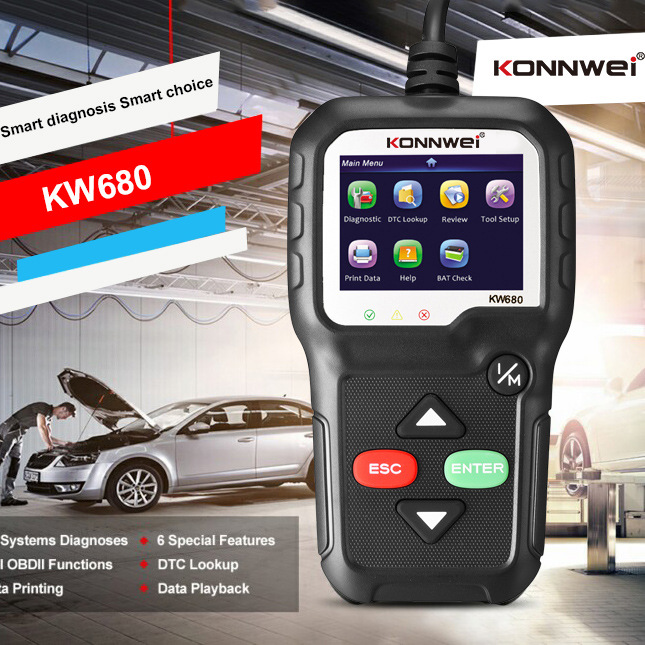
The KONNWEI KW680 OBDII/EOBD scanner supports all 10 OBDII testing modes for comprehensive diagnostics. Equipped with the unique patented One-Click I/M Readiness Key, a TFT color display, and an internal speaker, the KW680 truly represents the best combination of power and affordability, enabling users to complete tasks more quickly. Additionally, thousands of troubleshooting code tips assist technicians in saving time during diagnosis and repair.
Scanner Features & Functions:
*Works on all 1996 and later OBDII compliant US, European, and Asian vehicles
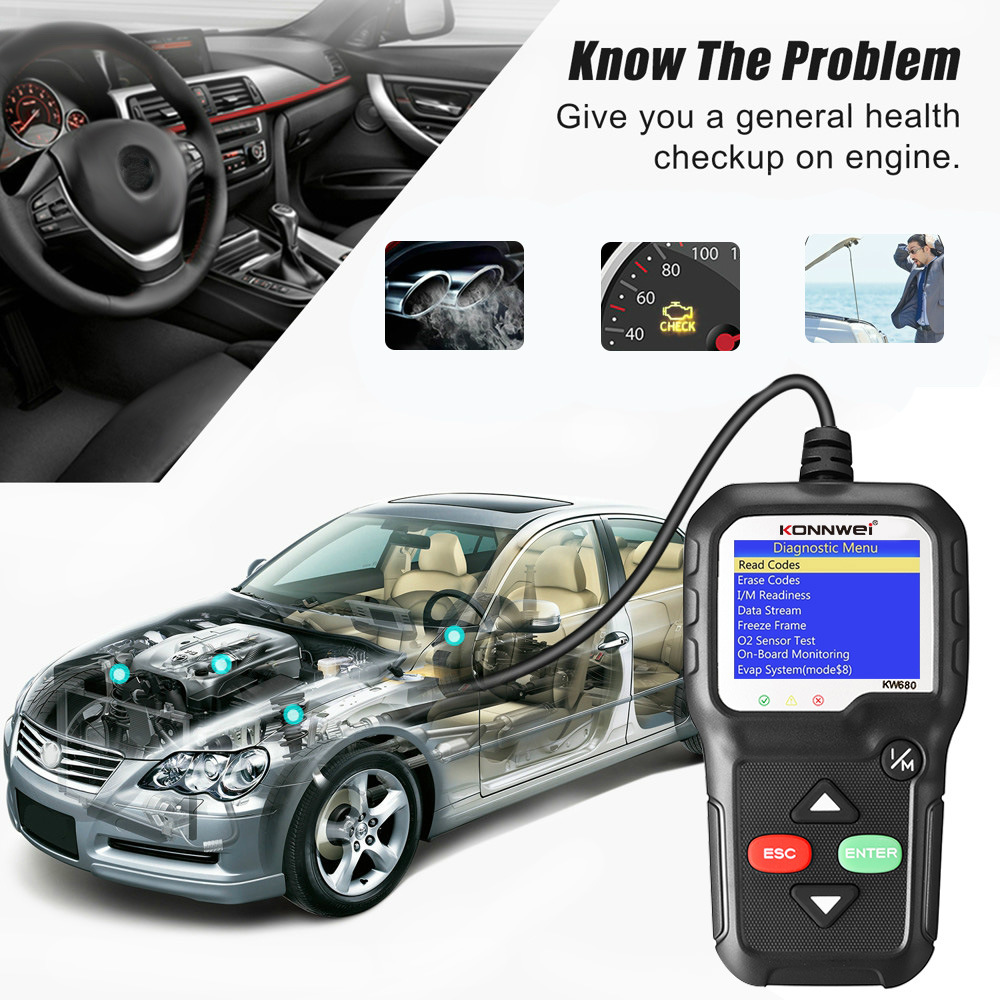
*Easy to determine the cause of the Check Engine Light (MIL)
*Retrieves generic (P0, P2, P3, and U0) and manufacturer-specific (P1, P3, and U1) codes
*Turns off Check Engine Light (MIL), clears codes and resets monitors
*Displays DTC definitions on the unit screen
*Viewing freezes frame data
*Displays the monitor and I/M readiness status (emissions)
*Identifies pending codes
*transcribes the live PCM data stream
*Displays real-time O2 sensor test data
*Graphs data C (1996 and later)
*Reads, stores, and plays live sensor data
*Memory/battery backup for off-vehicle data review and analysis
*Supports eight languages: English, French, German, Dutch, Spanish, Russian, Portuguese, Italian
*Conducts the present module test
*Retrieves vehicle information (VIN, CIN, and CVN)
*Supports CAN (Controller Area Network) and all other current standards</t)_current Standards
*OBD-II protocols
*Built-in OBD-II DTC lookup library
*Large, easy-to-read backlit LCD screen
*Software can be upgraded via the internet
*Displays data via PC
Included accessories:
1) User's Manual
2) A USB cable
3) A color box
4) Protective Nylon case
Car Fault Diagnosis Instrument KW680 Chinese Instructions:
Vehicles that comply with OBDII protocols can be tested. This includes CAN, J1850PWM, J1850VPW, ISO9141, and KWP2000 protocols. KW850 is easy to use; it offers full OBDII function testing, customized data stream display, and graphical visualization options.
Features and Characteristics:
- Vehicles from the United States, Europe, and Asia that comply with OBDII protocol after 1996 can be tested.
– Identify the cause of the engine fault light to resolve or understand the issue with the vehicle.
- One-click decoding, easy to use.
– Through clear coding, temporary faults in the ECU are removed, and the fault indicator light turns off accordingly.
- Read the sensor information of the engine.
- Read frozen frame data to obtain sensor information when the vehicle malfunction occurs.
– Testing of the vehicle’s support capabilities regarding OBDII.
- Read the status of the oxygen sensor test.
- Read the status of the online component test.
– Check the operating status of vehicle components.
- Read vehicle information. (Chassis number, engine verification number...)
- Custom data streams. (The data shows an in-depth analysis of the data streams of interest)
– Data streams can be visualized graphically.
- Supports eight languages: English, French, German, Dutch, Spanish, Russian, Portuguese, Italian
- It can detect the voltage of the car battery
- Free online upgrades available: http://www.itoscanner.com
- Supports 5 major protocol modes: CAN, J1850PWM, J1850VPW, ISO9141, and KWP2000.
- Fault database dictionary.
– Certified under CE, FCC, and RoHS standards.
Basic working principle:
When a vehicle system fails, the MIL light or the check engine light turns on. At the same time, the Powertrain Control Module (PCM) stores the fault information in memory. The fault code is then read from the PCM via the device. Based on the fault code, the nature and location of the problem can be quickly and accurately determined. Targeted inspection of relevant components, component boxes, and wiring is performed to resolve the issue.




Update time:


TOP


