Search history
Clear allSearch by image
XDrag and drop an image here or upload an image
Max 5MB per image
UploadSign In | Join

Search history
Clear allSearch by image
XDrag and drop an image here or upload an image
Max 5MB per image
UploadSign In | Join
|
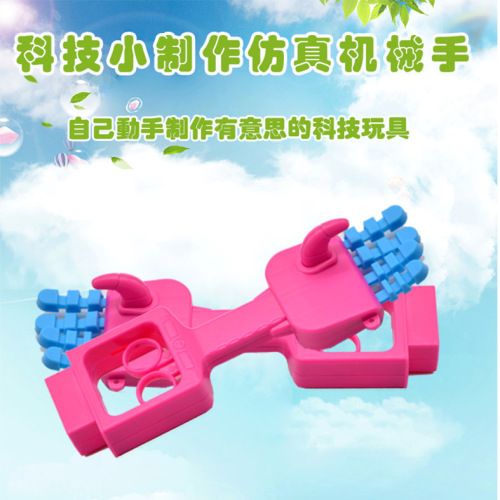
kx864 simulation manipulator
KX864仿真机械手 |
CN¥ 0.0 |
Model Number: KX864
Name: Simulated Robotic Hand
Number of boxes: 500
Size: 17*5*5.5 CM
Outer box dimensions: 60*50*55 CM
Robotic Hand Course Presentation Materials
An automatic operating device capable of imitating certain movements of the hand and arm to grasp, move objects, or operate tools according to a fixed program. Robotic arms are early industrial robots and modern robots as well. They can replace heavy labor of humans to achieve mechanization and automation in production, operate in hazardous environments to protect personal safety, and are therefore widely used in industries such as mechanical manufacturing, metallurgy, electronics, light industry, and nuclear energy.
The tiny robotic hand possesses magical power, which can help us pick up heavy objects. As long as you control its control system, it will obediently bring you the things you need. Do you want to have your own robotic hand? Then let’s study it together!
The robotic hand is primarily composed of three main parts: the hand, the motion mechanism, and the control system. The hand is the component used to grasp workpieces (or tools). The independent movement modes such as lifting, extension, and rotation of the motion mechanism are referred to as the degrees of freedom of the robotic hand. To grasp objects in any position and orientation in space, six degrees of freedom are required. The more degrees of freedom there are, the greater the flexibility and versatility of the robotic hand, and the more complex its structure becomes. Generally, specialized robotic hands have 2–3 degrees of freedom. We all know that robotic hands are very efficient in operation; they can easily lift objects heavier than themselves. So how do they work? Let’s explore that.
Let’s all take a look at the structure of the robotic hand we will be working on soon. We will find that its hand resembles a parallelogram. A parallelogram is a quadrilateral where two pairs of opposite sides are parallel to each other within the same plane. No matter how the shape changes, the opposite sides of a parallelogram remain equal, and the angles are also equal.
Moreover, we found that each connection point is a small lever. A lever is a rigid rod that can rotate around a fixed point under the action of force. Levers can be used in many aspects of our lives—helping us save effort or time.
Efficient lever examples: bottle opener, juicer, nut extractor...
Leverages that require less effort, such as: scissors, nail hammer, nail puller...

Update time:


TOP