|
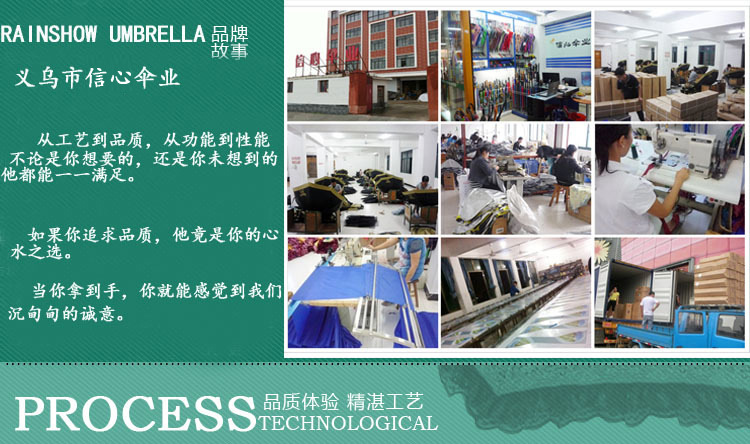
 Yiwu Xinzhen Umbrella Factory is a umbrella manufacturing enterprise that integrates development, production, and sales. Established in 2000, the company operates a first-class production line with a workshop covering 5000 square meters. It produces over 10,000 umbrellas daily and has a high-quality design and management team. They offer free design of patterns and precision printing (high-quality screen printing and thermal transfer printing). There is also a professional sample-making team, providing meticulous and considerate service. The product quality is strictly controlled and continuously improved, with timely delivery. The company is highly trusted by gift companies, foreign trade firms, and large procurement groups. It holds independent import and export rights, exports over 100 containers annually, and is a key player in the umbrella industry nationwide. Its products include more than 200 varieties such as straight-rod umbrellas, folding umbrellas, beach umbrellas, golf umbrellas, sun umbrellas, pencil umbrellas, children's umbrellas, and tents....... "Integrity as the foundation, dedicated service, and shared development" is the business philosophy of this company.
 1. After using the umbrella, it should be placed in a well-ventilated, dry place to be opened and dried out. A small amount of lubricant should be applied to the ribs and handle to prevent rust and mold.
Before opening the umbrella, shake out the canopy, straighten the ribs, and then open it slowly to prevent breaking.
3. Do not hang the umbrella on a lime wall that is alkaline, which can prevent the umbrella surface from becoming brittle.
4. Do not use the umbrella to pick up objects, do not use it as a walking stick, and do not let it come near high temperatures, which can prevent the umbrella from deforming.
5. The new umbrella should not be left unused for long periods, as it may become brittle and deteriorate due to prolonged storage.
6. Additionally, the sun umbrella should be cleaned thoroughly, dried, placed at room temperature for a while, and then stored. It should not be exposed to very hot sunlight, as this can cause the umbrella surface to age, become brittle, and break easily.
7. When folding the umbrella, hold the top of the umbrella tightly. Try not to use sweaty hands to touch the area where the folded parts meet the umbrella surface, so as to avoid leaving marks that could affect its appearance in the future.
 The unique patterns on umbrellas can effectively showcase individuality and attract attention, which is why many businesses use them as promotional items—making them genuine printed products. The most commonly used printing methods for umbrellas include screen printing, hot stamping, offset printing, digital thermal transfer printing, rotary screen printing, and machine thermal transfer printing... Of course, each printing method has its own advantages. Silkscreen printed umbrellas are relatively inexpensive, and the quantity requirement is not very high. However, there are some limitations regarding colors. If there are many colors, large printing areas, or color effects with gradients, it becomes challenging. Of course, with continuous improvements in silkscreen technology, full-color printing on large areas can now be achieved. However, the cost and processing fees are not cheaper than thermal transfer printing. Offset printing is usually used for printing on paper, employing thermal transfer dispersing ink to transfer patterns from paper to fabric at high temperatures. Some refer to this as thermal sublimation. But offset printing has limited printing areas and is done on single pieces, so it can only be used for individual items.logoAbove. The advantage of thermal transfer printing is that there are no restrictions on colors, the color reproduction is high, and it can be printed in small batches. However, the downside is that the cost is significantly higher compared to silk printing. The most economical option is rotary screen printing; the plate cost is low, and the printing fee is also inexpensive. However, a lot of fabric is wasted for the plates, and the printed patterns are not very vivid. Additionally, there are constraints—printing must be done before coating, so there may be some distortion in the final design. If high precision and economy are desired, then thermal transfer printing by machine is the choice, although the plate cost is high and the minimum order quantity is large. Therefore, the best option depends on the specific requirements.


|