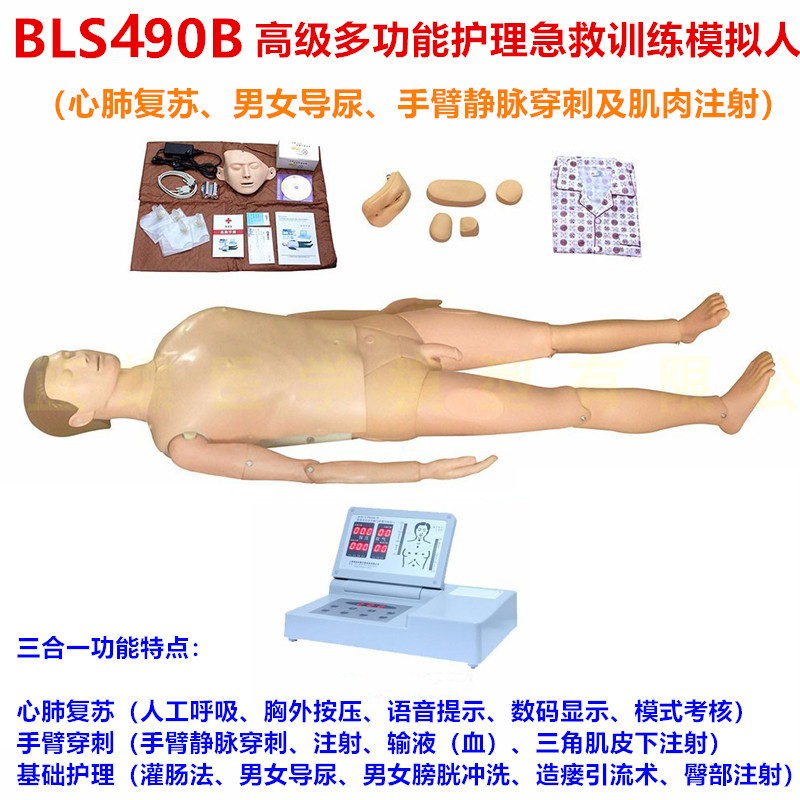
Advanced Multifunctional Nursing and Emergency Training Simulator (Cardiopulmonary Resuscitation, basic nursing and male/female catheterization, arm vein puncture, and intramuscular injection)
Model: BLS490B
Material: silicone, PVC, etc.
Execution standard: AHA 2015 Guidelines for International CPR & Cardiovascular Emergency Care
Main functions:
★ Cardiopulmonary Resuscitation:
■ The mannequin has distinct anatomical features, a realistic hand feel, uniform skin tone, lifelike shape, and an attractive appearance.
■ Simulated vital signs:
? In the initial state, the simulated human's pupils are dilated, and there is no pulsation in the carotid artery.
During the pressure application, the simulated human carotid artery shows passive pulsation, with the pulsation frequency matching the pressure frequency.
? After the rescue, the simulated human pupil returned to normal, and the carotid artery resumed spontaneous pulsation.
? The pupil dilation and carotid artery pulsation can be enabled and disabled via a switch.
■ Artificial respiration and cardiopulmonary resuscitation can be performed. Standard airway opening can be carried out, and the airway indicator light turns on.
■ Three operation modes: capable of performing CPR training, mode assessments, and real-world assessments.
? Method 1: CPR training, which includes compression and ventilation training.
Method Two: Pattern assessment. Within a set time limit, according to the 2015 International CPR standards, perform 5 cycles of operations with a ratio of 30:2 for correct compressions and breaths.
? Method 3: Practical assessment, where the instructor can set the operation time range, standards, number of cycles, frequency, and the ratio of pressing to blowing.
Controller display screen functions:
■ Electronic monitoring: Electronic indicators show the airway opening and compression sites. Counts of correct and incorrect breaths and chest compressions.
■ Voice prompts: Chinese voice prompts are used throughout training and assessment. The voice can be turned on or off, and the volume can be adjusted.
■ Barcode indicates air volume: The correct air volume is 500~600 ml to 1000 ml:
When the airflow is too low, the barcode appears yellow.
When the airflow is appropriate, the barcode appears green.
When the airflow is too high, the barcode turns red.
If the tidal volume blown in is too fast or excessive, it causes the indicator light to illuminate; digital counting displays an error; incorrect language alerts appear;
■ The barcode indicates the pressing depth; the correct pressing depth is 5–6 cm:
When the pressing depth is less than 5 cm, the barcode is yellow.
When the pressing depth is between 5-6 cm, the barcode appears green.
When the pressing depth exceeds 6 cm, the barcode turns red.
■ The operation time can be set manually in seconds.
■ Operation frequency: 2015 standard is at least 100–120 times per minute; users can also set their own values.
■ Power status: Uses a 220V power supply, which is regulated by a voltage regulator to output 12V power. (A lithium battery can be added optionally for direct use without an external power source.)
Printer Features:
■ Print the operation process after cardiopulmonary resuscitation is completed.
■ The report includes information on operation methods, cognitive assessment, first aid breathing techniques, pulse examination, respiratory checks, removal of foreign objects, operation frequency, compression and ventilation ratio, number of cycles, the number of compressions and breaths per cycle, correct/incorrect compressions, causes and counts of incorrect compressions, causes and counts of incorrect ventilation, causes of incorrect ventilation, set time, operation time, and assessment evaluation.
★Basic Care:Arms vein puncture, injection, infusion (blood), deltoid muscle subcutaneous injection, enema procedure, female catheterization, male catheterization, female bladder irrigation, male bladder irrigation, stoma drainage procedure, buttock muscle injection.
■ Material Features:
Face skin, neck skin, chest skin, and hair are made using imported thermoplastic elastomer mixed adhesive materials (silicone materials). The torso and head are crafted from high-quality ABS engineering plastic, produced via high-temperature injection molding using stainless steel molds; the limbs are made from PVC plastic material through mold casting processes. Components such as injections, punctures, and reproductive organs are made from imported silicone rubber. These products feature accurate anatomical markings, realistic touch, uniform skin tone, lifelike shape, attractive appearance, durability, resistance to disinfection and cleaning without deformation, and easy disassembly. Their materials reach the same level as those abroad.
■ Standard set configuration:
One full-body human model has been revived;
One electronic digital display;
One recovery operation pad;
Barrier facial mask (50 pieces per box); 1 box;
4 sets of lung sac replacement devices;
A creature with interchangeable skin;
2 rolls of thermal printing paper;
One disc of guide material;
One first aid manual;
User manual, warranty card, certificate of conformity.


 bls490b resuscitation and nursing manikin
 resuscitation and nursing unit (without controller)