Usage Tips
Standing
(1) “T”-shaped standing posture: the left heel touches the inner side of the right foot, forming a “T” shape, with the upper body slightly leaning forward.
(2) Adopt the “v” stance, spread the toes apart and bring the heels together, pressing the wheels inward.
⑶ Parallel stance legislation: Stand parallel with two feet at shoulder width, with the upper body slightly tilted forward.
Note: During standing, avoid inward or outward movement of the feet. Keep the blade perpendicular to the ground, and maintain a good standing posture during normal movements.
⑷ Crouching position: The upper body is tilted forward, with the shoulders and back slightly higher than the hips. Both hands are held together or moved naturally. The legs are bent, with the upper body forming an angle of 15–20 degrees with the ground, and the knee joints at an angle of 90–110 degrees, while the ankle joints are at an angle of 50–70 degrees.
Note that you should experience the squat position exercises for each movement during practice.
Weight shift exercise
(1) Standing and stepping in place
Wear the roller skates, stand with both feet parallel and at shoulder width, legs slightly bent, upper body slightly forward, arms naturally hanging down.
Center of gravityMove to the left leg, lift the right leg slightly then lower it; shift the center of gravity to the right leg, lift the left leg slightly then lower it. Repeat this process gradually increasing the speed.
(2) Single-foot support balance
On the basis of maintaining stillness, keep your original posture, hold onto the railing or a companion, shift your weight to one leg, extend the other leg sideways and then retract it back to the starting position. Repeat this action with the opposite foot.
⑶ “Eight” Shape Walking Exercise
Stand with feet in an outward "V" shape, shifting the center of gravity to the left foot. Step forward with the right foot, shifting the center of gravity to the right foot. Then lift the left foot and step forward again, shifting the center of gravity to the left leg. After that, lift the right foot and step forward, shifting the center of gravity to the right leg. Repeat this process.
Stand in place, first shift your weight to the left leg, draw in the right leg, take a step forward on the outer side of the left leg to form a crossed position, then shift the weight to the right leg. Next, draw in the left leg and take another step to the left to return to the starting position. Repeat this exercise; also practice taking steps to the right.
Straight road sliding
(1) Single-foot grounding and double-foot sliding exercise
The right foot pushes off the ground, shifting the center of gravity onto the forward-sliding left leg. After pushing off with the right foot, it quickly aligns with the left foot for sliding, followed by the same action with the left foot pushing off and aligning. Repeat this alternating motion for forward sliding practice.
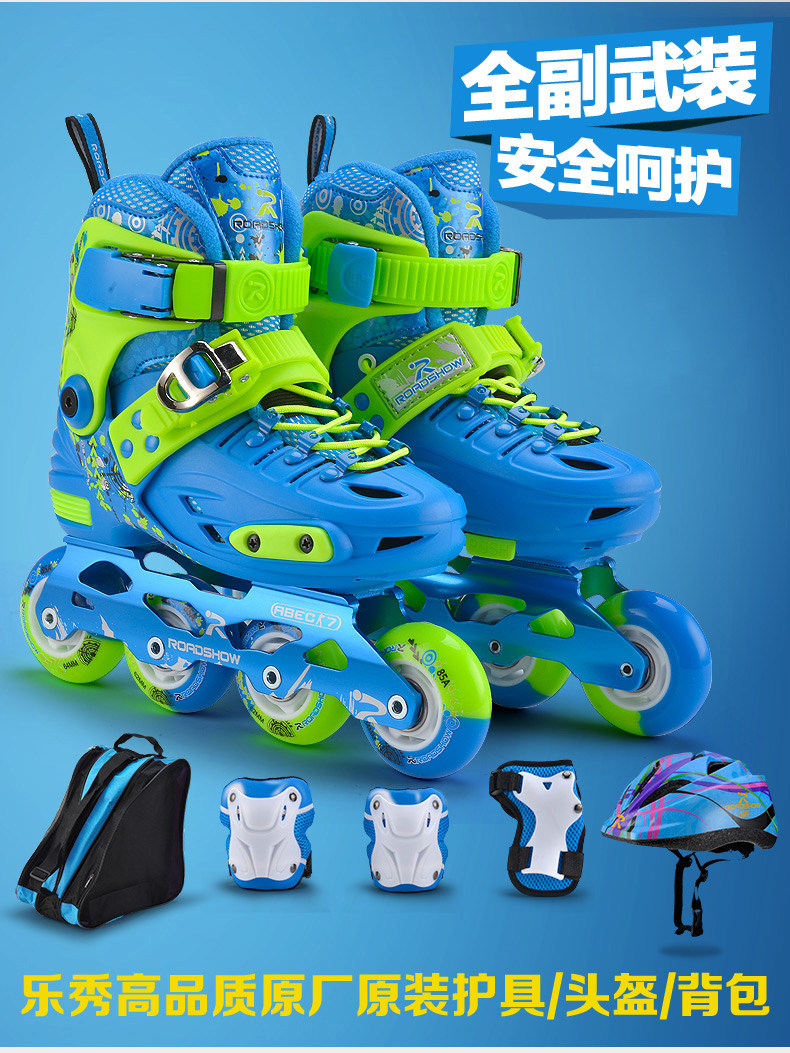
roller skates
(2) One-foot push off the ground and one-foot glide
Legs forward, arms hanging naturally, feet slightly apart, standing in an outward "V" stance. Shift weight to the right leg, push off with the inner edge of the right foot, and slide the left foot forward forcefully. As the push-off ends, shift weight to the left leg, allowing the left leg to remain in a half-squat position for inertia sliding. Then pull the right leg forward while pushing off with the left foot. After the left leg's push-off is complete, shift weight to the right leg in the half-squat position for inertia sliding. Repeat this process. Try to gradually increase the duration of each single-leg support.
During practice, pay attention to mastering the technique of single-foot support. Make sure your nose, knee of the supporting leg, and toe are all aligned on the same vertical line. During the support process, do not use the inner blade for sliding.
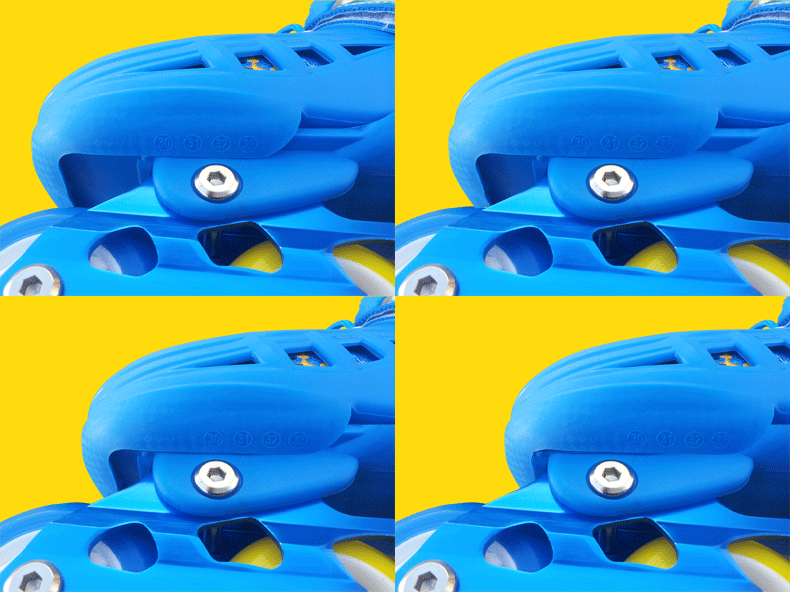
beginnersIt is recommended to keep the tool rest perpendicular to the ground.
⑶ Arm Swing Exercise
Just move the arms naturally, but avoid moving them too far apart.
Curvaceous sliding
The characteristic of sliding around the curve is that due to centripetal force, the body not only needs to tilt forward but also tilt inward toward the turn. Pay attention to practicing turning to the left side. Try to avoid sliding in the opposite direction; if doing so, reduce speed and choose to slide on the outer circle.
(1) One foot supports while the other foot continuously pushes off the ground for gliding motion
Starting from the standing position, the right foot that pushes off the ground uses its inner edge to push off, then quickly crosses over with the left foot. Next, the right foot performs another pushing-off motion, while the left foot continues with forward-outer movement.
curveSliding. Make sure the foot on the turning side is in front, with the toes of the push-off foot positioned between the supporting foot. Then swap between the supporting and push-off feet for practice.
Stop
(1) Using fixed objects
Slide towards the wall or any reasonably fixed object, using your arm for cushioning at the moment of contact. This is suitable for low-speed situations (when touching the wall, remember to turn your head to avoid hitting your face against the wall). Note that you need to learn how to use your arm for cushioning (just like when standing).
Push-up(t_XXXXXXXX) You can practice like this: put on shoes and stand 1-2 feet away from the wall, lean against it, and use your hands for support. You should experience a slight bounce, provided you avoid hitting your head against the wall. The faster you move against the wall, the less the bounce. Human brakes are more effective; make sure to choose a familiar and skilled partner, and warn them when you are approaching.
(2) Brake pad braking
For beginners, this method is also quite easy to use. However, as skills improve, the brake pads may become an obstacle. For example, when performing the cross-step, there might be a risk of tripping... Step forward with the right leg first, with the toes off the ground and the heel pressed down. The center of gravity should be between the two legs. At the beginning, it may slightly fall on the foot behind you. The key is to keep your back straight and your knees bent during the movement.
⑶t-stop
During the sliding process, place your weight on the right foot. Bend your right knee and lift the left foot, placing it across the right foot in a “T” shape. Then use the sides of the left foot to rub against the ground to slow down the sliding speed until you stop. Alternatively, you can use the left foot to support the right foot and place it across. Throughout this process, the majority of body weight should be on the foot that maintains the sliding motion. At high speeds, applying more pressure to the foot behind you can help you stop quickly. Remember that most of the body weight remains on the front foot.
⑷ Quick stop of both feet
Not everyone can do it, especially something like suddenly changing the angle of the foot by 90 degrees. You’d need to ask an expert... Mastering this move requires time and courage. This braking method is not suitable for beginners due to some risks.
⑸ Feet together, then gradually stop
When you want to slow down, first slide on your feet, then press your feet together tightly (without lifting them), and you will gradually stop. Note that this method is not suitable for rapid sliding, and your feet cannot be completely pressed together to avoid tripping.
In Yuanhui District, Luohe City, Lexiu roller skating store sells popular roller skates and speed skating shoes in the consumer market. It holds a high reputation among consumers. The company has established long-term and stable cooperative relationships with multiple retailers and agents. The roller skates and speed skating shoes distributed by Lexiu roller skating store in Yuanhui District, Luohe City, offer a wide range of products at reasonable prices. Lexiu roller skating store in Yuanhui District, Luohe City, has strong capabilities, values credit, adheres to contracts, and ensures product quality. By offering a variety of products and adopting the principle of small profits but high sales, it has earned the trust of a large number of customers.