Product Name: KX1932 Wind Power Light
Model Number: KX1932 Wind Power Light
Size: 105*60*180 mm
Weight: Approximately 120g
Material: wood + motor + circuit board + bulb + fan blade + glue
Color: Wood Tone
Battery usage: No
Packaging: 300 pcs
Box dimensions: 600*450*550mm
The environmental pollution is still quite severe at present, and environmental protection has become the mainstream. Everything is moving towards more sustainable practices! In the past, we generated electricity using coal, but this caused air pollution, which led to the invention of wind turbines. Today, we will build a simple wind turbine using common materials. A wind turbine converts wind energy into mechanical power, which drives the rotor to rotate, ultimately producing alternating current electricity. The working principle of a wind turbine is quite simple: the wind wheel rotates under the action of wind, converting wind kinetic energy into mechanical energy on the wheel shaft. The generator then rotates to generate electricity driven by the wheel shaft. Broadly speaking, wind energy is also solar energy; therefore, a wind turbine can be considered a thermal energy generator that uses the sun as a heat source and the atmosphere as the working medium.








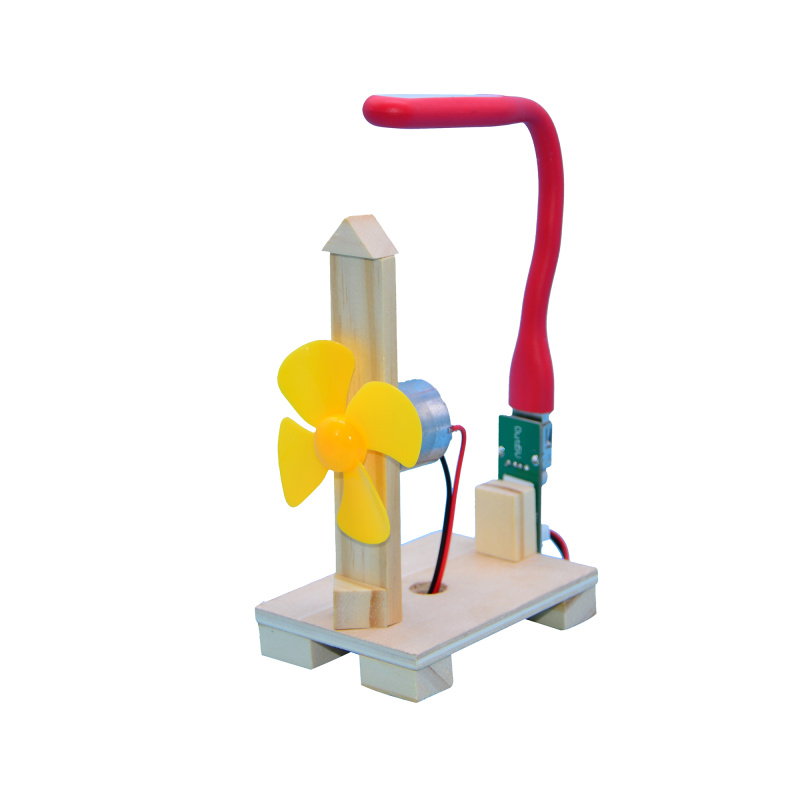

Wind turbines are power devices that convert wind energy into mechanical work, which drives the rotor to rotate, ultimately producing alternating current electricity. Wind turbines generally consist of components such as the wind turbine blade, generator (including its installation), director (tail fin), tower, speed limit safety mechanism, and energy storage device.
The working principle of wind turbines is relatively simple. The rotor rotates under the action of wind force, converting wind kinetic energy into mechanical energy on the rotor shaft. The generator then rotates to generate electricity driven by the rotor shaft. Broadly speaking, wind energy is also solar energy; therefore, wind turbines can be considered thermal energy generators that use the sun as a heat source and the atmosphere as the working medium.
For centuries, wind turbines, like hydraulic machinery, have served as power sources to replace human and animal labor, playing an important role in the development of productivity. The widespread use of mechanical and electrical power in modern times, along with the discovery of oil fields in the Middle East in the 1950s, slowed down the development of wind turbines.
In the early 1970s, due to the "oil crisis," energy shortages emerged. People realized the instability and limited supply of conventional mineral energy sources, so seeking clean, renewable energy became an important issue in the modern world. Wind energy, as a renewable and pollution-free natural energy source, has once again attracted attention.
It is an electrical device that converts wind energy into mechanical energy, and mechanical energy into electrical energy. Broadly speaking, it is a thermal energy utilization engine that uses the sun as a heat source and the atmosphere as the working medium. Wind power generation utilizes natural energy, which is much better than diesel power generation. However, for emergency use, it is still inferior to diesel generators. Wind power generation cannot be considered a backup power source, but it can be used over a long period.
The principle of wind power generation is to use wind to drive the blades of a wind turbine, and then increase the rotation speed through a speed increaser in order to enable the generator to generate electricity. According to current wind turbine technology, electricity can be generated at a speed of approximately three centimeters per second (a gentle breeze level).
Wind power is becoming a popular trend worldwide, as it has no fuel issues and does not produce radiation or air pollution.
Wind power generation is popular in countries such as Finland and Denmark; it is also strongly promoted in the western regions of China. Small-scale wind power systems are highly efficient, but they consist not just of a single generator unit, but a complex system with advanced technology: wind turbine + charger + digital inverter. The wind turbine comprises the rotor, shaft, tail fin, and blades. Each component is crucial, and their functions are as follows: the blades capture wind energy and convert it into electrical power through the rotor; the tail fin ensures that the blades always face the wind direction to maximize wind energy; the shaft allows the rotor to rotate flexibly to enable the tail fin to adjust its orientation; the rotor is a permanent magnet, and the stator winding generates electricity by cutting through magnetic field lines.
Due to unstable wind volume, the wind turbine generates alternating current ranging from 13 to 25 V. This AC must be rectified by a charger, followed by charging the battery to convert the electrical energy produced by the wind turbine into chemical energy. Then, an inverter power supply with a protective circuit is used to transform the chemical energy in the battery into standard 220 V AC power, ensuring stable operation.
Mechanical connection and power transmission: The blade of the horizontal shaft fan is connected to the generator drive shaft via a gearbox and its high-speed shaft through a universal elastic coupling. This coupling should possess excellent damping and vibration characteristics, capable of absorbing appropriate amounts of radial, axial, and angular deviations, and it can also prevent overloading of the mechanical device. Another type involves direct-drive fans, where the fan blade is directly connected to the motor without a gearbox. Motor type