
Search history
Clear allSearch by image
XDrag and drop an image here or upload an image
Max 5MB per image
UploadSign In | Join

Search history
Clear allSearch by image
XDrag and drop an image here or upload an image
Max 5MB per image
UploadSign In | Join
|
mixed wholesale
混批 |
CN¥ 0.0 |
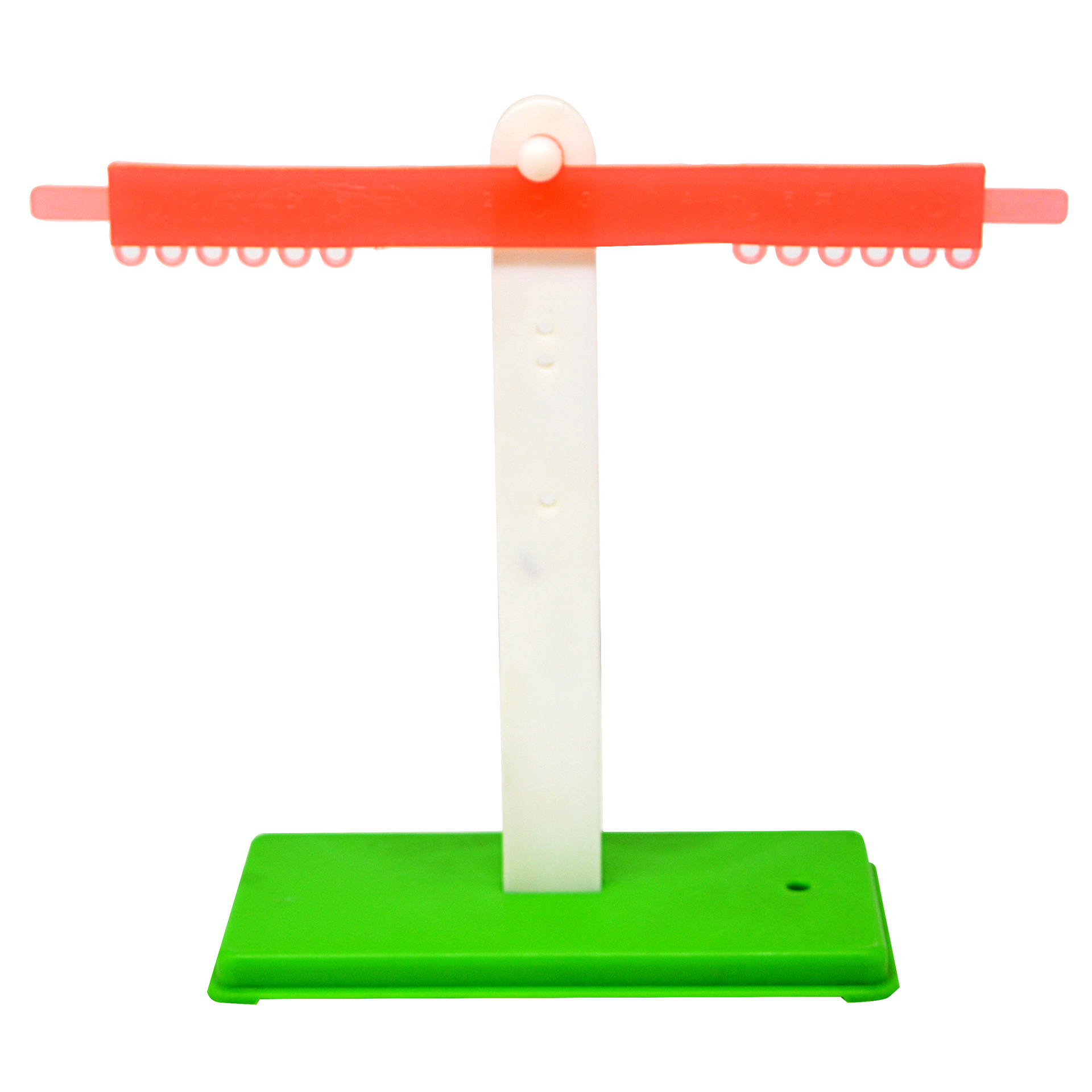
leverage ruler and bracket
scientific inspiration:
archimedes once said, "give me a fulcrum and i can pry up the earth." in real life, although no one can move the earth, with the help of this fulcrum, many things with weight can be moved. through the following experiment, let's see how leverage saves effort.
scientific production:
1, know experimental apparatus: small butterfly shaft, weight, nut, small weight, fine copper wire, plastic wire, balance ruler, hook, body, base, large column.
2,install the big column on the base, then install the sky and balance on the big column, and assemble a lever.
3, hang different numbers of weights in different positions of the balance ruler, observe and record the state of the lever, what rules do you find?
4, use three plastic thread ends to hang the butterfly through three small holes on small plate respectively, (fold and cut the copper wire in half) use copper wire to tie the hook and the three plastic wires at the same distance respectively, hanging in the small hole at both ends of the balance, use smalloring balance adjustment.
5, put small weights and weights in the butterflies at both ends of the balance to keep the balance. then put small weights of different weights and weights of different numbers into the butterflies on both sides to balance the balance. think about what principle balance illustrates? in the experiment, we found that,if the weight of the measured small weight is not equal to the weight of the balance balance, the balance of the inclined balance indicates that the weight of the weight is equal to the weight of the measured small weight.
tips:during the experiment, different weights were hung on different positions of the balance respectively.,made under the correct guidance of the teacher.
knowledge expansion:
lever principle is also called "lever balance condition". to balance the lever, the two forces acting on the lever (force point, fulcrum and resistance point) are inversely proportional to their actuating arm. power × power arm=resistance × resistance arm, expressed in algebraic formf1·l1 = f2·l2. in the formula,f1indicates power,l1indicates the power arm,f2indicates resistance,l2indicates the resistance arm. from the topout, to balance the lever, the power arm is several times of the resistance arm, and the power is a fraction of the resistance.
balance: a weighing instrument. the balance beam is supported by the fulcrum (axis) at the center of the beam to form two arms. each arm is hung with a plate, one of which is placed with objects of known weight, and the other is placed with objects to be weighed, the deflection of the pointer fixed on the beam when it is not swinging and pointing to the median scale indicates the weight of the object to be weighed. balance is a commonly used instrument in laboratory. balance is a weighing instrument and an instrument to measure the quality of objects. it is made according to the principle of lever. there is small kit at each end of the lever, one end puts the weight, the other end puts the object to be called, and the center of the lever is equipped with a pointer. when the two ends are balanced, the mass (weight) of both ends is equal. these principles are old-fashioned for people who have studied physics. modern scales are becoming more and more precise, sensitive and diverse. we all know that there are ordinary balances, analytical balances, constant analytical balances, microanalytical balances, semi-microanalytical balances, etc.
scientific inquiry:
1, carefully observe and think about what is the application of leverage principle in life? examples.
2, what is leverage
3, understand the relationship between balance and lever experimental key points:
4, the conditions and rules of lever balance.


Update time:


TOP


